Thursday, 26 July 2012

Indian Ocean and the Rimland


Before the First World War, Mackinder, a British geographer presented the first geopolitical idea in his research paper. He identified the combined land of Eurasia and Africa as World Island which represented the largest occupancy of land and people. During the phase of turmoil and the unsuccessful attempt of German invasion on Russia, Mackinder moulded his theory and presented the 'Heartland concept' in 1919. His famous quote was, "Who rules East Europe commands the Heartland; Who rules the Heartland commands the World Island; Who rules the World Island commands the World." This theory was further amended leading to criticism on the economic front, the, unfavourable physiography, climate and cultural attributes. 


In the meanwhile another significant scholar, Spykman presented the 'Rimland concept' in 1944, incorporating maritime Europe, crude-oil rich West Asia, agrarian and dense clustered India and China along with Heartland of Mackinder. In accordance Spykman concluded that the one who commands Rimland will command the world island and thus the world. On the economic front, Rimland with huge potentiality justified the validity of the concept. But on the political aspect, consolidated Rimland lacked its practicality with individual countries specifically of Asia posing as distinctive nodes. 


The rim countries barring the exception of Singapore and Australia are newly independent developing countries. The only entity which unites these nodes is the Indian ocean. Traced back to colonial times, the Indian ocean gained significance as the British Lake, with Colombo functioning as the naval headquarters. Indian ocean identified itself with strategically important locational characteristics in comparison to other oceans of the world. The continental ocean is bounded by land along the three sides making it geographically distinguished and known as the half ocean. 


In addition to this, the ocean connects the sea route between Atlantic and Pacific through the Suez canal and Strait of Malacca. The offshore crude-oil, exploitable manganese nodules, natural gas reserves and the onshore gold reserves, tin, manganese and the assortment of marine resources and the agricultural produce with the onshore reference adds to the commercial value. Thus there is a convergence of interests which has led to instability in the region. The existence of naval bases of UK and USA at Chagos archipelago and Diego Garcia in the Indian Ocean, the presence of navy of China under the viel of research in open seas and the so called 'string of pearls' adds to the growing significance of Rimland concept and ultimately the Indian ocean.


- Shivaprasad Patil 


The writer is a Civil service aspirant.


Twitter handle : @shivpatilb

Sunday, 8 July 2012

Re- Discovering History : Temples of India.


The word temple originated from the Latin word 'templum', which means  a structure reserved for religious or spiritual activities which includes prayer, sacrifices, or corresponding rites. However when we talk about temples the 1st thing that comes to our mind are those temples situated in India. The number of temples in India is innumerable, popularly known as “Mandir”. The word Mandir  means a place of worship. Both “Temple and “Mandir” though synonymous, the word 'Temple' is a bit wider term. Where temple includes all type of worship place in the world irrespective of religion, “Mandir” includes only those places of worship which have “Murti”, an idol worshiped only by Hindus


There is no written record of the establishment of the first temple or mandir. But if we look into the Hindu mythology, we will find that emergence of god and goddesses were due to the fear that dwelled in the people. Every natural calamity that destroyed, caused danger, death was attributed to the god of destruction. Other gods brought prosperity or profit and were worshiped by the people to please the gods.  For example they worshiped “Surya dev” the god of life, “Indra dev” the rain god for fertility, "lakshmi" the goddesses of prosperity and so on. Initially idols were not worshiped, it was later when people started imagining  as to how gods and goddesses might looked, that the ancient people started the art of sculpture and idol worship, however when the idol worship started, people started to feel a need of a shade to prevent these sculpture or idol from destruction  hence building of temples started.   


The earliest temples were made of perishable materials for example clay and timber which were destroyed way back and have no record today. Next was the cave rock cut structure where the dead body was buried and caved the grave with big rocks. The first such cave was created in Rajgir around 500 B.C. it was later that elaborated structural temples with complex architecture and sculpture came into existence. With the adoption of verity of styles, Gupta period marked the beginning of structural temples.  The temples were now built of stones and bricks. And thus an era of building of temple started in India so much so that today one can see a temple at every corner of the road. There is a great difference in the building style of temples of all the regions of India thus theses temples are categorized on the basis of their structure and design.


Thus temples in India are divided into 3 types on the basis of their construction:-


      The North Indian style (Nagra style)
      The western and Deccan style
      The Southern style (Dravida style)


 The North Indian style (Nagara style)


In this style we see projection on the outer side leading to cruciform shape where the temple is a square at the centre.  Each projection has been named, where there is one projection it is known as triratha, two projection, pancharatha, in case of three projections it is called  sapthratha and for four projection it is called navarath. These projections can be found all over the structure of the temple. These temple styles can mostly be found in Gujarat, Orissa and Rajasthan. The temple of Orissa are described as Nagara Style. These are the temples which managed to survive the destruction made in  several invasion in India and are still standing as an unique piece of art. The temple as well as the literature lays down the rules and modes of construction and are very well preserved in Orissa. In this particular style, the structure consists of two “mandaps”. The main shrine is taller and bigger in size while the other adjacent one is smaller and shorter “mandap”. The basic difference between both of them is the  “shikhara”. Temple presenting this particular style are:


The sun temple at Konarak
Jagannath temple at Puri
Rajarani temple
Lingaraja temple
Anantha vasudeva temple
Brahmesvara temple in Bhubaneswar
The Parasurameswara temple at Bhubaneswar .


However the oldest Hindu temple functioning today which has survived all the odds is Mundeshwari Temple situated in Kaimur district of Bihar. It is also the oldest Hindu temple in the world. It’s construction date is ascribed 108 B.C.


Western India and the Deccan Style (vesara style)


western India and Deccan style basically originated from the North Indian style. It is essentially a combination of Nagara and Dravida style. A typical example of vesara is Kajuraho temple. The Svargabrshma temple situated at Alampur in the state of A.P has similar characteristics. The trend of merging styles was started by Chaiukyas of Badami (500-753 A.D) who built temples merging the two different style if the Nagara and the Dravida. Temples built in Halibid , Belur and Somanathpur are classified under this style.


Temples built in Vesara Style are also found in other parts of India, including Baijnath, Sirpur, Baroli and Amarkanatk.
Oldest or Early temples of this style are:
Vaidyanatha Mahadeva temple at Baijnath
Sikara  Mahaseva temple at Baroli
Viratesvara temple at Sohagpur
Lakshmana temple at sirpur
Kesavanarayana temple at Amarkantak


The Prime temples of this style are:
Devi temple
Jawari temple
Adinath temple
Brahama temple 
Laiguan temple 
Lakshmana temple 
Parsvanatha temple
Kandariya temple
Charsath temple
Vamana temple
Matangeshvara temple etc.


Chandellas basically used the coloured sandstone for instance pale yellow, pink, buff colour in the construction of these temples. Temples were also made of Granite stones. Temples of vesara were dedicated to gods Shiva, Vaishnava however the Jain sects did not show great variation in style between one another.


The Southern style (Dravida Style)


Vimana and the Gopurams are distinctive characteristic of the southern style which developed in the Dravida Desam.  Vimana is nothing but a tall pyramid tower consisting of several progressively smaller storeys which stands on a square base, whereas Gopurams are are two storeys separated by horizontal moulding. Parakara (the outer wall) envelops the main place of worship as wall as the other shrines, the tank. 


All the mighty rulers of the south like the Pallavas, the Cholas, the Pandyas, the Nayaks, Vijayanagar, contributed a lot to this style of temples.


Pallava Temples: 
The Pallava temples generally have a somaskanda relief panel. Some of the Pallava temples includes Rajasimha temple, Olakkaneshvara temple, shore temple at Mamallapuram, Vaikuntha Perumal temple, Mukundanayanar temple etc.


Chola Temples: 
They erected a lot of temples and also renovated earlier brick structures in stone.
 Earlier Chola temples are Kamparhesvara temple at Triubvanam, Airavateswara temple at Darasuram, Brihadiswara temple at Tanjavur, Gandikonda Cholapuram, Narthamalai Komganatha temple etc.


Pandya Temples:
Pandyas mostly concentrated at the main entrance which they called  Gopurams. Typical Pandya style can be seen in Sundara Pandya Gopuram added to the Jambukesvara temple, east Gopuram, Great temple, Chidambaram.  In this style basic structure and the original style was maintained, but the decorations on the Gopurams and the size characterises the Pandya Gopurams.


Vijayanagar Temples:
The tall massive Gopurams and the multiple mandapas are the main contribution of the Vijyanagar Period. Another major feature of this temple is the carved pillars with the reasing simhas (lions), yalis (lions with elephant trunks). Vijayanagar temple was very different from that of Chola  here the entire temple structure was not unified whole like those in the Chola system. The number of mandaps, pillared halls, shrines to minor deities, tanks, etc was found to be absent in this form of temples, which was very much present in the chola system.  Important temples of vijayanagar period are Vitthala swami temple, Vijayanagar, the pillars of the Ekambaranatha temple.


Nayak Temple:
The main characteristic of temples of this period was the elaborate mandapas of hundred and thousand pillared type, the high Gopurams with stucco statues on the surface and the long corridors. Temples representing this style are The Ranganatha temple is known for the increase in the number of enclosures while the temple of Rameshwaram is known for it’s  long corridors. The Subramanya temple situated Brihadisvara temple court at Tanjavur is known for the fine vimana with arsha and maha mandapas. 


Thus one can actually see the variety of temples present in India each being totally different from the other. The influence of various kings, era and popularity of god and goddesses can be very well perceived in the construction of an assortment of temples of different states.  It must be noted that temples not only mean “Mandirs”, rather it includes all places of worship irrespective of caste, creed, religion or country some of the famous temples of the world are:


Temple of Hephaestus, a Doric Greek Temple in Athens, 449 B.C


Khmer Angko Wat Hindu temple in Cambodia.


Mesopotamian Temple (The Ziggurat of Ur)


    Egyptian Temples (Luxor temple,Egypt)


Greco- Roman temple (Parthenon on Acropolis, Athens)


             Zoroastrian temple ( Fire temple)   


                                               The Golden Temple, Amritsar    


            Hindu temple (Akshardharm temple, New Delhi, India)


Wat Phra Kaew (Buddhist Temple)


Jain temple (Rankapur Temple)


Links:
http://qna.rediff.com/questions-and-answers/what-is-the-meaning-of-this-word-mandir/5200003/answers 
http://en.wikipedia.org/wiki/Brihadeeswarar_Temple
http://www.navhindtimes.in/iwatch/oldest-temple-india
http://en.wikipedia.org/wiki/Mundeshwari_Temple
http://www.classicalkannada.org/DataBase/KannwordHTMLS/CLASSICAL%20KANNADA%20ART%20and%20ARCHITECTURE%20HTML/VESARA%20STYLE%20OF%20ARCHITECTURE.htm


- Kumari Ranjana Bharti


Tuesday, 3 July 2012

Rio+20: Will we get the future we want?


Recently concluded Rio+20 Summit, formally United Nations Conference on Sustainable Development; created much buzz-more criticism less applaud. The 10 day mega-conference involved 45,000 people including heads of states and ministers from 190 member states, businessmen, academicians and even religious leaders. Rio+20 was supposed to be the successor of Rio Earth Summit held 20 years ago, but ironically unlike Rio Earth Summit ’92 which brought climate change agenda to international politics and resulted in two ground breaking treaties on Climate Change and saving biodiversity; all Rio+20 culminated into was a non-binding document-“The future we want”-devoid of any detail and ambition needed to address the challenges posed by a deteriorating environment, worsening inequality and a global population.


How far have come since Rio Earth Summit 1992? Since then global emissions have risen by 48%, 300m hectares of forest have been cleared and the population has increased by 1.6bn people. Despite a reduction in poverty, one in six people are malnourished. Humanity's annual requirement for natural resources is about double what it was then. The rate of species extinctions is undiminished. Carbon dioxide emissions are up 40%, and the concentration of the heat-trapping gas this year for the first time hit 400 parts per million (ppm) in the Arctic air — up about 40 ppm from 1992. 


Even though Rio+20 aimed to discuss and charter a way forward to “green economy”; what it actually achieved is debateable.  Though the UN officials and Government representatives were optimistic about the outcome of Rio+20; Ban Ki-moon, UN Sec. Gen, said the document would guide the world on to a more sustainable path: "Our job now is to create a critical mass. The road ahead is long and hard." US secretary of state Hillary Clinton said it was a time to be optimistic. "A more prosperous future is within our reach, a future where all people benefit from sustainable development no matter who they are or where they live." But environment campaigners and scientists decried the summit, and were scathing its outcome. WWF International lambasted a "colossal failure of leadership and vision" and Greenpeace International Executive Director Kumi Naidoo called the summit a failure of epic proportions. "We didn't get the Future We Want in Rio, because we do not have the leaders we need.”


So what did Rio+20 achieve? 


“Plan” to set up Sustainable Development Goals (SDGs). Negotiators at Rio were unable to agree on themes, which will now be left to an "open working group" of 30 nations to decide upon by September 2013. Two years later, they will be blended with Millennium Development Goals


United Nations Environment Programme (UNEP) was not upgraded to World Organisation, as many stakeholders wanted, but would get will get a more secure budget, a broader membership and strong powers to initiate scientific research and coordinate global environment strategies. Rio+20 also established a "high-level" forum to coordinate global sustainable development, though its format is still to be defined.


“Green Economy” which was the buzzword at the Rio’s corridors was diluted by suspicions from some developing countries that this was another way for wealthy nations to impose a "one-model-fits-all" approach and raise “Green Barriers” to trade.


Nations agreed to think about ways to place a higher value on nature, including alternatives to GDP as a measure of wealth that account more for environmental and social factors, and efforts to assess and pay for "environmental services" provided by nature, such as carbon sequestration and habitat protection


All nations "reaffirmed" commitments to phase out harmful fossil fuel subsidies.


A plan to rescue the high seas – which are outside national jurisdictions – was blocked by the US, Nicaragua, Canada and Russia. Instead, leaders say they will do more to prevent over-fishing and ocean acidification. The International Union for the Conservation of Nature called the decision a "deep disappointment".


Developing countries were able to have their say and steer their concerns regarding environment and its economic and social costs.


An underlying characteristic of the Rio+20 accord was its vagueness, there were no quantified environmental or sustainability goals to which anyone committed to. The strongest initiatives have been taken at the sidelines of the summit, outside the negotiating halls. Significant agreements have been struck on investing in public transport, commitments made to green accounting by corporations and strategies agreed by cities and judicial bodies on reducing environmental impacts. The dynamism has been found in a 10-day "People's Summit”, running parallel to Rio+20 Summit, which saw more than 50,000 people participate in it to voice in their support for the environment. 


Transition to “green economy” and more sustainable development has economic costs, though all nations seemed to uphold the ideals of saving the environment but nobody wanted to put money on the table. Developing countries wanted a $30bn per year fund to help in the transition to sustainability, but in the midst of a financial crisis in Europe and fairly recent financial crises in USA, nobody was willing to say how much money they would contribute. Instead, there was a promise to enhance funding, but by how much and by whom were left to future discussions. This was sighted by G-77 countries as a major reason for a weak outcome. Paradoxically, the summit was supposed to introduce green economics as an answer to the financial crisis and as a springboard for growth.


Another reason for failure of Rio+20 was lack of trust between nations. The recriminations began even before the conference closed. British Deputy Prime Minister Nick Clegg blamed developing countries for being "antagonistic to our European ideas on the green economy." Brazilian delegate and Senator Eduardo Braga said, "Europe is too absorbed by its economic problems." Brazilian president Dilma Rousseff said rich nations had not kept Copenhagen promises on "green funding" and so were in no position to criticise others for a lack of ambition: "All countries must take responsibility. Nobody can point the finger."


Rio+20 witnessed some interesting trends. Unlike Rio Earth Summit ’92 which attracted every world leader including the reluctant George H.W. Bush, Rio+20 had important world leaders like Obama, Angela Merkel and David Cameroon missing; is this indicative of leadership deficit or question of priority in view of upcoming presidential elections for Obama and financial crises at home for Merkel and Cameroon, is open to interpretation. Another important trend was intense participation of private sector, with UN claims that more 1500 top corporate leaders attended the summit. If governments can’t be decisive, Corporations can be. Private corporations seem to have got the scent that “green economy” means a lot of new business, and why not? Commoditization of environment and Carbon Credit trading is just indicative of the fact that Environment is going to be the next hotspot for investments. NGOs warned in Rio that if nature had a dollar sign attached, corporations would soon take it over. How prescient these predictions are time will tell. 


Though Rio+20 did not live upto the expectations, as the overall governmental commitment and resolve was conservative, but it charted a way forward which clearly demarcates that public-private partnership and individual commitment to saving the environment will play a crucial role if we want to materialise the future we want or else we will be more culpable in Rio+40!


-Sudhanshu Sharma

Sunday, 1 July 2012

Sands and Diplomacy


It was in Jalore, a remote district in South-western Rajasthan where this fine idea invaded my neurons. The idea which will be developed and revealed gradually like a muddy stream flowing in it’s deltaic stage has a bearing on the future of the political common-sense. Jalore falls in geographical region which is historically known as Marwar. In fact it is one of the sub-region of Marwar called Godwad. The region is uniquely adorable for it’s Raikas with 50 meter long pagdis and thousands of sheep, it’s jungle temples frequented my merchant like milk loving bears, Jain sadhus and sleepy babus in their vintage lal battis. The marriage which I was attending was one of the typical feudal marriage of Rajasthan with it’s Langa performances, got(meat eating feast with buckets of whisky), Rajput thikanedars with their big mustaches poorly hiding the vanishing finances and old glories.
                 
 There, I came across many people. Some of them were quite interesting like the hawala seth (very much like the mirchi seth from Sarfarosh) and a local MLA who was quite anti- Civil Society. But, I am not going to write anything about these interesting ones but I am going to discuss the one who was the most unpleasing or rather irritating one but who planted a great idea in my mind. I begin with a great thanks to him.
                  
 He was an IFS officer with 7 years of diplomatic experience. For obvious reasons I am not going to divulge his name but he was an Indian diplomat who began his conversation with a complaint that since he was IFS he won’t get a good dowry thanks to the IAS officers of his community. That really kicked. I wanted to hear more and talk more.
                 
 I initiated a discussion on public policy and public diplomacy. He replied that “public is always a public. It can not have a policy and it is not just capable of doing diplomacy.”Mark the word ‘doing’ here.  Initially I thought that it was some piece of diplomatic wit but soon it turned out that it was a piece of scattered wit. He meant it literally. He had no idea of what public diplomacy actually is. Soon enough I asked him why he hadn’t opened a Twitter account given the nature of his job as someone who should be well- connected with the world. He replied that the last time he wrote any sensible thing was 7 years back when wrote an essay on women empowerment in his IAS exam. I replied that I found it rather cool that 7 years ago he was thinking about women’s empowerment/. He was on 7th heaven to learn that. What had me astounded was the question that followed. He asked me, “Does that make me a suitable candidate for the MP’s post?” Worried more than ever I now asked, “When are you standing for the elections?” “Post- retirement,” he replied with a natural ease. That was a good 30 years from now I argued and till then it must be diplomacy, not politics. He retorted in a rather drab tone that diplomacy began with his coaching classes in Mukarjee nagar and ended the day he got his appointment letter.
             
Later, when I mentioned names like Jagat Mehta, Samuel Huntington, Francis Fukuyama, Pratap Bhanu Mehta they were like physics and chemistry formulas for him. He said I really don’t know calculus. I said, they are great public policy experts. Jagat Mehta is from your state.You must know him. He only said one sentence, “In sab bekar ki baton me kya rakha hai. Jab UPSC ke exam me inke bare me nahi padha to ab kya zarurat hai. Exam ke baad to maine newspaper bhi padhna band kar diya.” [What’s the point knowing these people. When I studied for the UPSC exams I never came across these names, why bother now? In fact I have stopped reading the newspapers as well.] He was least interested in knowing anything about Amitav Ghosh, Gabriel Garcia Marquez. He could not speak for 2 minutes fluently in English. But yes he was regaling his friends and cousins with his escapades with blonde girls. The only virtue which he had was that he was not arrogant and bossy like other babus. He could drink the lowliest of wine and call it  a Johnny walker.
    
 Today a batchmate for St.Stephens’s called me from the U.S. He did  MSFS(Masters of Science in Foreign Service) from Georgetown and was thinking of joining Indian Foreign Service. He asked me about the UPSC exam. I told him that it is something which goes on for two-three years and it is capable of failing Henry Kissinger in International Relations as optional. He asked me if there was any alternative system of recruitment based on interview, SOP or lateral entry in civil services. In fact he found it quite funny. He is already a graduate in foreign service and according to him his degree should be sufficient. Before our conversation ended he said, "I am not interested in taking this exam as I already have an offer from Brookings Institution.I just want to serve my country but not at this big a cost.”
I said good bye and hungup the phone.


Later in the evening he rang me up once again and announced his decision that he is joining Brookings institution. I am not very happy to learn about this. He could have been an asset to this nation if he had joined our diplomatic services. But we do not have anything for these people and this makes them land up in U.N and Brookings because the latter two know their worth. Our system just does not go beyond conventions, customs rigid exams (which makes diplomats and administrators out of engineers, doctors, linguists and historians)
     
Why can’t we begin with some change? When the U.S can appoint Vali Nasr, Francis Fukiyama ,Brett Mcgerc as policy advisors and ambassadors than why can’t we send our Ved Pratap Vedics, Brahma Chellanys, Achin Vinayaks, Narayan murthys etc as our envoys and high commissioners. We can give a chance to Indian students (who want to join our civil service and diplomatic service) who go and study public policy and diplomacy courses at places like Cornell, Princeton, Fletcher, Harvard etc to join our civil services and foreign services. There is no need to subject them to UPSC exam (as most of them already have good job, offers from MNCs, thinktanks etc so we have to somehow get this talent) They can simply write an SOP and then shortlisted candidate should be called for an interview. Finally selected candidates can start with a 6 month orientation course and then parceled to their foreign postings or field postings in India(if they ar in administrative services).These students are professionals with a good exposure, knowledge,and dynamic personality. They can do a great service to our country.
    
Recently Farid Zakaria raised a big question mark on our foreign policy and our whole foreign service set up. He wrote that a nation as small as New Zealand has 11,000 diplomats and on the other hand India ,who dreams of game changer role has only 600 diplomats.So ,I believe it is the right time to think out of the box and get Kissingers and Bismarcks for India.
          
 Finally it is our choice,who do we want to represent us ? 
a)The fellow who cremated the diplomacy the day he was appointed(after passing a great,great and greatest exam!) or the fellow from Georgetown for whom diplomacy is a passion, mission of his life but must rely on an exam to prove his mettle.


-Abhinav Pandya


The Writer is a Fellow at the Cornell University pursuing his MPA and a proud alumni of St. Stephen's college, Delhi


*Note: The incident narrated in the article is based on actual events.

Wednesday, 20 June 2012

Indo- Japan Bilateral Relations: A Brief Assessment.


The first exchanges between India and Japan were cultural, due to indirect spread of Buddhism from India to Japan via China & Korean peninsula, gradually culminating into trade and economic ties, a classic example of how soft-power can be a crucial pivot in international relations. However, direct exchanges, began only during the Meiji Revolution (1868-1912) when Japan started its modernisation. From then on, bilateral relations developed around Japanese purchase of the Indian cotton and after the World War II on import of iron ore. Trade helped in solidifying relations which were once initiated by a great religion.

Since 1952, Japan and India have maintained diplomatic relations and enjoyed cordial relations based on trade, economic and technical cooperation. Relations developed steadily as Japan's imports of ore and exports of manufactured products increased. Following Japanese Prime Minister Nobusuke Kishi's visit to India in 1957, yen loans to India began in 1958, as the first loan aid extended by Japan. In 1958 Japan participated in the Consortium Meeting of India's creditor countries hosted by the World Bank and embarked on the full-scale assistance to India that has continued to the present. Since fiscal 1986 Japan has been India's largest aid donor.

Till 2010, cumulatively, Japan had given India 3,600 billion yen in ODA, 89.56 billion yen in Grant Aid and 29.35 billion yen in Technical Cooperation. Japanese cooperation has focused on upgrading of economic infrastructure, alleviation of poverty through public health and medical care, agricultural and rural development and population and AIDS countermeasures support for small business, environmental conservation and technical up gradation.

In 2010-11 bilateral trade between Japan and India, hovered around 13 billion USD. Principal commodities of exports from India to Japan are garments, iron ore and chemicals, while imports include machinery, mechanical parts, auto components and chemicals. A recent CII study on Indo-Japanese economic relation concluded that, “The trade between the two countries is expanding rapidly. India and Japan are expected to achieve the trade target of $25 billion by 2014”. The potential areas for economic cooperation include capital goods, auto parts, iron, steel and chemicals, it added.

India has actively pursued economic reforms and market oriented economy since 1991 and Japan is an integral part of India’s growth story. India providing high profitability has become a lucrative destination for Japanese investment. Japanese giants like Sony, Nissan and Suzuki already have manufacturing facilities in India and Maruti-Suzuki is a household automobile brand in India. High domestic demand, availability of skilled manpower and healthy markets are the major drivers of Japanese investment in India. Major chunk of these investments are focused in transportation, telecommunications, fuel, chemicals and trading sector. Many Japanese investors feel that India still has ground level hassles like labour laws, overall infrastructure, and taxes, legal and regulatory framework. Japan proves to be an alluring destination for Indian investors due to its skilled human resources, cutting edge technological innovations and excellent infrastructure.

India wants the focus of Indo-Japan bilateral trade to be on FDI rather than ODA. In a recent development, Japan has planned to explore natural gas jointly with India; the joint exploration will be led by the private sector. Japan wants to diversify its sources of natural gas as it currently relies on imports for 97% of its needs with Indonesia, Malaysia and Australia being the major suppliers.

India and Japan’s bilateral ties have strategic implications. Japan’s strengthened ties with India can be viewed as an effort to contain the increasing (often aggressive) presence of China in western Asia. Moreover, both India and Japan are legitimate contenders for a permanent seat of United Nations Security Council (UNSC) and prospective tie-up between the two on this issue can increase their collective bargaining power for the same.

While Japan is implementing structural economic reforms, India is in the process basic economic reforms. The Japan-India Joint Declaration of December 10, 2001 has set the ball rolling for things to shape up in Indo-Japanese relationship in the 21st century. To raise the bilateral relationship to a “qualitatively new level" is the ultimate of the Joint Declaration. Broader and deeper economic relations between the countries would form the cornerstone of this bilateral relationship.

Both the countries are strongly committed to an "open and non-discriminatory rule-based multilateral trading system". Indo-Japanese trade relations and economic cooperation is going stronger by the years, though, if compared with neighbouring China's trade with Japan, India's share in Japan's total trade does not give any impressive look. So also in the field of foreign direct investment. Japan, which is the fourth largest investor in India itself, is not happy with this rate. India has to do a lot to create an investor-friendly environment through speedier economic reforms and freeing the country from clutches of deregulation at the earliest.

The paragons of Indo-Japanese relations are transcending the realm of economy and trade. Japan is considered as a key partner in India’s “look east” policy. These close relations have culminated into the Delhi Metro Project, Yamuna River project, Joint Defence & Naval exercises, Agreements on Civil Nuclear Energy and most recently Japan has also supported the reconstruction of Nalanda University, an ancient Buddhist centre of learning and has agreed to provide financial assistance for the same. Not only are Indo-Japanese bilateral relations mutually beneficial and integral to growth of both nations, but also are crucial for prosperity and balance of power in Asia.  


- Sudhanshu Sharma

@SSharma2217 on Twitter

The Writer is currently working at Standard and Poor's and is pursuing his Masters course in International Business.


Sunday, 17 June 2012

Open Letter To All...


Dear Friends, 

Change is inevitable & change is the only thing constant.
Tharoorians for Change too undergoes a change today!

It has been brought to our notice by Dr. Shashi Tharoor, MP himself that "Tharoorians For Change" has been misconstrued as a Fan club blog, largely undermining the seriousness of the issues being taken up via this medium.

The Inspiration behind this blog, Dr. Tharoor has been instrumental in shaping our thoughts for a Better and Brighter Future for India and it would be unfair to undermine his support and encouragement and belittle the writers efforts by terming Tharoorians For Change as a mere Fan club blog.

After much reflection however, it has been decided in consultation with Dr.Tharoor, that the blog be renamed as 'Progressive Indians for Change' instead. 

Our sincerest thanks to Dr. Shashi Tharoor who so kindly acquiesced in our using his name on the blog and for his incessant encouragement on Twitter. Our best wishes to him as he moves forward in India's political arena as Change Maker! We eagerly look forward to his comments and compliments on our writers' works as we embark on this new journey.

Indeed we all remain ''Tharoorians" in spirit though the blog and our writers who grew rather fond of the name won't be carrying the name formally anymore. 

I take this opportunity to invite every Indian to take part in this quest for change. 

This is not the end, only a new beginning! 

Eagerly look forward to your participation!

Regards & Best,
Katherine. Abraham

Twitter Handle: @Indian4Progress

Email: progressiveindians@yahoo.com

Sunday, 10 June 2012

“System Kharab hai yaar!”


From the poor and downtrodden slum dwellers to the uber social business class residents in Antillas, the rant is one and the same, “System Kharab hein yaar!” To mend the ‘Kharab’ system, post reform India has witnessed a flurry of activists drumming up support to further their cause promising a land flowing with milk and honey. But most of these movements have lost steam in the course of time or have been restricted to certain pockets in the country. Of late most hyped 'India Against Corruption' movement did have the right combo in principle to change the system in Indian context but it turned out to be a pathetic flop in its execution. For the youth bubbling with energy and are intellectually armed, socially oriented and have passion and conviction to make a change, the principles used in the movement shines forth as the ultimate reference point.

Here are the salient features of this well planned and meticulously thought out movement which fell from grace in the sight of the people because somewhere down the line even the people realised that the 'Purpose' had been deviated from. The knowledge of this is helpful in bringing about a change in the Indian ‘Kharab’ system.

Exploit the Context
To launch a movement the prevailing mood in the society plays a decisive role. The IAC movement took off from the 2G launch pad acquiring a 4G speed. Witnessing the country being plundered mercilessly by corrupt politicians and the memories of Arab spring still fresh, the people craved for an outlet to express their anger against the corrupt system. At this juncture ‘India Against Corruption’ pitched in as the outlet to channel peoples hatred against the government. 

The Mascot and Tagline
For any brand or mega event, a mascot or the brand ambassador symbolically represents and magnetically attracts people with their mass appeal. Even though India Against Corruption was the mastermind of a few renowned, the movement fizzled off rather quickly. The Gandhi topi became a ‘style quotient’ and Satyagraha venues became a popular hangout location for the virtually obsessed city bred generation. For the villagers it was a nostalgic moment in revisiting the ways of the man who knew them better than any other Indian leader. The tagline ‘I am Anna’ also became an instant hit.

Rural and Urban Connect
India Against Corruption adopted an inclusive advertising strategy that included pasting posters in the brick walls in villages to posting information in virtual walls in facebook. For the cost conscious Indians, the idea of a ‘missed call’ to extend support was a ‘What an Idea Sirji’ move that struck the chord among the masses quickly. Shrewdly botched up corruption figures coupled with shrewdly prepared one liners and messages posted in blogs, twitter and facbeook along with SMS hoaxes led the people out from the comforts of vituality to the streets of reality. 

The Men Behind
The people running the show under India Against Corruption banner were stalwarts in their field of activity. Very quickly they were successful in creating a division between politicians and civil society. The IPS, IIM, Lawyer tags associated with the key leaders and the ‘aam admi’ tag attached created a halo to pull people together. Thus they virtually declared themselves as the spokespersons of civil society proclaiming the mandate of 1.2 billion people.  

The Sun Set
So why did this plan fail when in principle all the above mentioned factors provide the best frame work to change the ‘Kharab’ system. 

The cause for failure of the Civil Society movement, is not the fundamental principles which it propagated but the mode and application

The men behind the movement were overambitious at the sight of thousands taking to the streets. The strong basics of the movement remained but they erred in the later build up. Even though the people gave thumbs up initially when the leaders of the moment started taking elected representatives head on and started ridiculing, the wanton targeting of few leaders triggered the landslide. India Against Corruption may have dreamed of a mass uprising like Jasmine revolution of sorts but the corruption issue apart, they failed to understand the strength of the proven grand old Indian democratic system. Also, the invisible partners demanding their share of credit, the controversies surrounding the top leaders and the irresponsible statements played a crucial role in weakening the movement. 

Let’s be the Change
Before dreaming of high profile acts like bringing government to the toes, the change makers should start with little things to change the ‘Kharab system.’  For the system to change, that attitude of the people has to change. Change doesn’t happen overnight. The dream of transforming the India with a movement that only calls for more trouble is foolishness. The change has to happen at the roots, only an organic growth will bring about a credible change. For anyone dreaming to change the ‘Kharab system,’ The principles of Civil Society movement has to be adopted from the root level, beginning with organizing like minded people, effectively using the online medium, being a contrasting presence at place of work and the like to bring about lasting change. 

The change makers need not hit the streets with massive uprisings. It’s the little drops of water that make the mighty ocean. For example, a responsible and consistent blogging initiative would turn out to be a little drop that would act as a catalyst in creating the mighty ocean of change. Let our aim be high and actions grounded and realistic!

It is essential to understand that stray movements hold the people’s attention and can possibly even attract them in this fast paced Information Technology driven world but what we need to understand is the fact that in any country, there is nothing better than to work concomitantly with the Government rather than against it. The Government is comprised of the Elected Representative of the People.

 Why can’t we place some more trust in the MPs we selected?

- Jeff Shawn

@jeffshawn on Twitter

The Writer is a Student of Philosophy and writes for the popular site Mutiny.in

Thursday, 31 May 2012

Something is Wrong!


It’s been almost one and a half months since I wrote my 12th grade Board Examinations. During this period everyone, be it family or strangers that I met ask me one question, “Which Engineering College are you planning to join?” Or “Which Engineering course are you intending to study?” I replied honestly that I had no intention to do so and they give me a weird look. Their reaction, as I understand, is of disbelief and pity. They pitied ‘my foolishness’ to have ignored the hallowed 'engineering' field. 

It’s almost blasphemy for a science student to think beyond Engineering and Medicine. Let me give you a few statistics. 
India produces 7,50,000 engineers every year. Of these, almost 40% scout for a job for almost a year, while around 22 % take almost two years before bagging a job.
There are more than 2,00,000 unemployed engineers in India.
Only 25% engineering graduates in India are employable.
Most of the students who join private engineering colleges have only around 50 to 60% marks in their 12th grade. (Most of these students are forced by their parents to pursue a career in Engineering.)
Who is to be blamed for this pathetic situation? I’m not willing to spare anyone!

Parents

Parents are increasingly becoming disappointed, not because their child did not get an engineering admission but an IIT coaching institute’s admission! I do not question the intentions of the parents; they want the best for their children. Unfortunately, most parents do not understand their own child’s pluses and minuses. Is it right to force a child to write IITJEE and AIEEE, when he/she is not able to pass simple Physics class tests? Parents need to move beyond “My son/daughter is studying engineering” now almost a fashion statement. What values are they imparting to the children, when they ‘buy’ seats for a few lakhs? Is education like potatoes and tomatoes to be bought in the market? 


To quote Kahlil Gibran,

Your Children are not your Children
They are the sons and daughters of Life’s longing for itself.
They come through you but not from you,
And though they are with you yet they belong not to you.

Parents have no right to impose their dreams and aspirations on their children. Parents need to shed this "what-will-others-think" syndrome. They need to sit down and discuss with an open mind as to what the child is interested in and allow him to pursue his dreams.

Schools

Currently, schools are busy with rat race for marks. When your teacher is more interested in teaching you what might and what might not come for the examination rather than the concepts, you know something is wrong. When there is no freedom of speech in morning assemblies or space for radical thoughts/experimentation, schooling kills individualism.

It is high time that the focus must be on careers and not marks. Career counselling must be introduced in schools. Schooling must be a period where you discover yourself and bring out your individuality. Schools must not be a factory churning out conveyor belt products.

Students Themselves

If, at the age of 18 you are not able to decide your fate, I confess I find it rather hard to believe. When you can rebel for smart phones and bikes, what stops you from raising your voice for your Own life? At times, it is not absolutely necessary to be an obedient child. But you know your limitations better than anyone, even your parents. Have the courage to say ‘No’ without being a rebel. Yes its difficult, but not Impossible!

In the information era, ignorance is definitely no excuse. Students need to understand that internet is not just about Facebooking and tweeting. Why not use Google to check on fields beyond engineering? Why have we all forgotten Robert Frost’s ‘Road Not Taken’ poem which we learnt in the 9th grade? 

Sadly the material world has made 'Money' the single motivating factor for many aspirants. It is a vicious cycle. Parents pay for a degree; the student wants the returns as soon as possible sometimes to pay off loans, but most often it is in the pursuit of harvesting money. India is blessed with a demographic dividend. It could all become a myth, if the youth lack values and vision. Here I find it necessary to say, I admit there are exceptions. 

There are numerous other bright career opportunities available including civil and defence services. India needs vibrant and robust youth, who can take the country forward.  

The purpose of humanity is self expression. What are you going to express when you have mortgaged yourself to an engineering college? Your purpose is not to fall in line with majority but to fight against the odds.


In conclusion, it is my humble request, 


Dear Friend, Have the courage to pursue your dreams. Take up a career which  you love. 

Karthik Narayan

@karthiknarayan1 on Twitter

The writer has just completed his Twelfth Board Exams successfully.

Monday, 28 May 2012

The Tweet that Wasn't!

An Aspiring diplomat's observations of India's Finest diplomat's Political Achievements.


If one randomly skims through the newspapers of 2009- 2010 you will notice at least a couple of articles every month on the the new diplomat turned politician, Dr. Shashi Tharoor. It was almost as though the following day's headlines and the Op-Ed columns were revolving around a 140 character view- point of a social- media savvy Minister who was breaking the hallowed rule of silence maintained faithfully by the government's representatives. The obloquy of the media forced the Indian politicians on Twitter to exercise a policy of caution and succeeded in making the others desist the idea of a 'direct connect'

Fast forward to 2012 and you see Shashi Tharoor continues to tweet, expressing views, opinions and even catering to citizen issues that call for immediate attention as candidly as he did before. One is abreast with the latest developments courtesy the tweet-meme. So what has changed? To put it simply, The Media- Attitude.

As a Law student the first rule that is etched in one's mind is the need for Evidence that proves your case beyond reasonable doubt. So here are a few tweets from this year which will help you understand the scrupulous measures undertaken by this Member of Parliament despite the brickbats he received in the past. What is grossly disappointing is that that none of these tweets which throw light upon the essential have found their way to the media in the way an absolutely frivolous comment like 'cattle- class' did. The larger question here is, Does the Indian Media thrive on trivia for higher readership? Is substantive journalism slowly turning into an archaic concept? Is the Indian media now the ghetto redolent of minutia owing its failure to shed light on those predicaments that affect the citizen? The affairs of the State deeply impact every citizen directly or indirectly. However, while national causes get larger coverage, one is absolutely oblivious of steps taken on the International front to improve our relations with other countries. 

 To turn the tables, here is an episodic view of the last five months of 2012 using the same 'tweet' that once stung people, to highlight work done, issues  undertaken and opinions of consequence.

On the Maldivian shift to democracy.


On the Rinkle case that took India by storm.
On the Indo- Russian diplomatic relations
As a UN diplomat, Dr. Tharoor still recommends India to work independently before it seeks UN help.


On Israel.


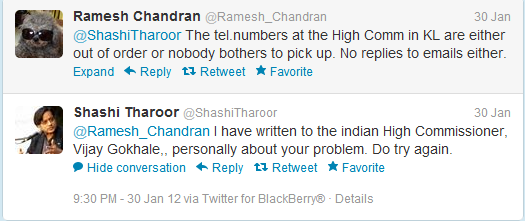
Dr. Tharoor on a private citizen's plea for help personally takes up the cause.

On the Norway custody row.

On the lesser discussed Latin American ties.
Yes, one learns a lot via Dr. Shashi Tharoor


What you've just read is only a glimpse of the good work that has gone unnoticed. This politico- diplomat leaves no stone un- turned when it comes to India's International Relations and prefers to share his views in black and white. One finds this MP adopts a unique and ubiquitous approach that any mature Indian reader will relate to. What is distressing is the fact that these views are currently restricted to one platform. One is forced to ask if the Media can spend enough time hounding leaders on triflings, isn't it befitting that the Indian reader should know the fact that these leaders also move beyond their realm of being Ministers, adopt a humanitarian approach to work for the greater good?


The aim of this post is not only to highlight the conscientiousness of the Member of Parliament but also to create an awareness among readers about the 'objectionable selectiveness' which has become the motif of the Media. Sparring Twitterati are blessed with the limelight for the extra spice in the newspaper. The concept as Twitter as a medium of political exchange is still in the pipe.

DEALING WITH INDIA'S FOREIGN RELATIONS

The point of inquiry in the second part of the article is, Are we utilizing the skills of our visionaries enough? Is it not time for the dynamic  members in the Parliament to lead from the front rather than render support from the periphery? Is it not apt that India begins to incorporate the younger Ministers to assume the reign, while the older sapient generation supports them from the background. 

Here the aim is not to demean or disregard the service that the older Parliamentarians have rendered, but as a growing democracy is it fair to choose to live with rigid principles and laws that the older generation clings to. 


Must seniority always trump caliber in the Indian political arena?


It is imperative to explicitly convey the idea to the reader vis-a-vis an example. Very recently the Ministry of External Affairs was faced with an Indo-Italian crisis wherein two Indian fishermen were killed by two Italians while at sea. Media houses deliberated on the possible consequences this incident would have on the international relations between the two countries, the Ministry of External Affairs was still deliberating on possible ways to maintain amity between the two countries while political analysts decided to unilaterally decide who was right and who was not. It was in the midst of this chaotic mess, Dr. Tharoor opined, "If both countries deem it fit, India could deliver the sentence, but the guilty delinquents could serve their sentences in Italy." A middle ground had been found. And that is the essence of being one who has spent a lifetime searching for solutions and more importantly finding ways to implement them rather than the adopt the stance of the Ministry wherein one hardly gets more than a statement by the Honourable Minister.

This is the change that India deserves. Political chicanery can and must take a back seat especially when dealing with International Relations because within the country one can belong to the Congress, the BJP, the BJD or any other party but while dealing with geopolitical issues all these divisions are inconsequential. India is then represented as a whole. 

We need problem solvers. The need of the hour is fore- thought concomitant to skillful diplomacy and not false prudery. We need leaders who will enhance the country's repute in the global community. Shashi Tharoor has been a world icon for over three decades now. Although a new-comer, this leader has achieved much more than many of his comrades. If India deserves the best why not gracefully hand over the Ministry to these able hands sooner rather than later?

It is quintessential that India must retain its position as a charismatic fore- runner in an ever changing world rather than portray itself as a country that is bound by the fetters of age and seniority.

 If the price of the Indian success is dedication, hard work, and an unremitting devotion to the things you want to see happen, here is a leader who epitomises all three and as a responsible citizen who is bestowed with a right to voice an opinion, I believe that we have in Dr. Shashi Tharoor a perfect choice to steer the way ahead for Ministry of External Affairs. 


Having said that, I rest my case.

Please Note: The views and opinions expressed are not subject to media scrutiny.
All twitter handles apart from Dr. Shashi Tharoor's have been duly notified. 

Katherine. Abraham
Moderator

@katie_abraham on Twitter

The Writer is a Law student and an aspiring U.N diplomat.


Friday, 25 May 2012

A Vociferous Bihari's appeal...Please Change!

The fact that I am a Bihari makes people think I am an illiterate,
The fact I am a Bihari makes people to look down upon me, 
The fact I am a Bihari, I am kicked out of everywhere.  
The fact I am a bihari, I am blamed every time 
The fact I am a Bihari makes me fit to be abused in every sense.
 But still, with my head held high am proud of myself for the fact, “Yes, I am a Bihari” but before that, 
‘I am a Proud Indian!’

It was midnight when the train for some 1st yr. Engineering students was delayed by eight hours. The young people decided that they would not spend the night on the isolated railway station in Kalyan (Mumbai) and decided to go take a room at the nearby hotel for the night. They went to a hotel close to the station, where initially they were very warmly welcomed at the reception. As is customary, the students were asked to make an entry in the register placed at the reception table. They filled in all the details, but a tiny phone number changed everything. The students  were confused as to which number they should enter, the one which they used in the hostel at Dawangiri (Karnataka), or the number they used back home in Patna. Sensing their discomfort the receptionist looked at their confused faces and watched them converse in their mother tongue. Within minutes he closed the register and all of a sudden informed them that there was no room available. The students stood perplexed as to what had changed within minutes. It was then that they were asked where they were from. As soon as the students mentioned the name “Bihar” the manager asked them  to leave at once. The students had no place to go and spent the night sleeping on the chairs at the station.

  One of the students who bore the brunt that day for nothing at all was my brother. This is one of the many incidents that we as Biharis face.  Every Bihari has to face some or the other mental disturbance owing to the lack of friendly treatment that they get outside their state. The next incident I recount is the reason why I found it imperative to write this article. This simple incident that happened with my sister, made me question, ‘Why?’

My sister an excellent student is a graduate with history majors, and holds an M.B.A. She went for a job interview in a school in Gurgaon. The principal was very impressed with her and the job was almost fixed, till she asked a very minor question at the end of the interview, as to where she hailed from. On hearing the answer the principal denied the very same person who impressed her a few minutes ago the job which otherwise she was fit for.  The answer : “BIHAR!

“BIHARI?” At times I look at this word and wonder as to what’s wrong with the word, why the single word ruins a career, causes a job denial, a shelter- denial? Why is Bihari always a criminal mind for others?

Above all my question to the readers : ‘Is being Bihari a crime?
How long will we have to listen to the abuses within our mother land and for how long will we have to go through the embarrassment of being a Bihari?

It is distressing, when the educated Indian reiterates such hurtful statements. Often during discussions on India or any topic related to Bihar I hear only the negative side of the State being highlighted.  We sometimes speaks through our own experience and many a time we speak through other’s experiences. Bihar has been a victim of bad governance for 15 years (which is too long) but today it is trying to uplift itself despite the odds. Bihar was recently awarded for the fastest growing states of India. Still people continue to believe in the myth that it is the most poor backward, illiterate state of the nation. And thus ‘Bihar’ has become the synonym of, corruption, violence, failed governance, backwardness, and poverty.

There are a lot of hidden facts about Bihar that people are unaware, Given below are just few of them:-

1. Bihar has comparatively more no. of graduates than Kerala and Andhra Pradesh combined.
2. As compared to Maharastra and Gujarat, the number of ‘Biharis’ in the IIT field is more. In fact 17 just from one district “Gopalganj”. 
3. The crime- rate in Mumbai  is double that in Bihar. (unlike the common misconception that people still hold.)
4. The number of people killed in communal wars in Bihar is 1/75th of Gujarat.
5. Bihar produces a greater amount of wheat than Punjab.
6. Bihar consist of more number of literate people as compared to Kerala and Karnataka together.
7. Bihar alone produces more no. Of IAS officers than Kerala, Karnataka, Tamil Nadu, Andhra and Gujarat combined together.
8. Bihar is the only state in India where till date no farmer has committed suicide.
9. The number of female graduates in Bihar is more than those of any other state. 

Bihar's History is one that every Indian ought to be proud of:

1. It was here that Buddha gave his first thought.
2. It’s the place where Rishi Valmiki wrote Ramayana, the greatest epic of the world.
3. It’s that very place where Chanakya wrote his first book on Economics.
4. It is the land where Lord Mahavira founded Jainism.
5. The father of surgery, Rishi Shushrut lived in this soil.
6. The Kamasutra was written here, by Vatsayana.
7. It was the land of Ashoka the Great.
8. Aryabhatt, the most ancient mathematician was from Bihar.
9. It’s  the place which still preserves the world’s best and the most ancient university, “The Nalanda University” 
10. Ashoka chakra comes from the very place Bihar, which today adorns India’s national flag.
11. It gave India it’s first president, Dr Rajendra Prashad.
12. This soil had produced a lot more eminent writers, poets and artists. 
13. Sher Shah who defeated the mightiest Mughal Emperor and who introduced the Postal System and Rupiya  in India was born in Bihar.
14. The 10th guru of  Sikh was born in Bihar
15. Mahatma Gandhi started the civil disobedience movement from Bihar.
16. Ramdhari Singh Dinkar the National Poet of India was born in Bihar.

We might know some of the facts stated above but many, we don’t. It’s time that we should stop following or repeating talks that we have been hearing since ages and via highly unreliable sources. If we really want to comment about anything, we should and must know the facts about it first. And why do we even have to comment on it anyways? And if it is a problem, it still is a part of India and it’s our duty to cure it, just the way we take care of each and every part of our body .   We call biharis  “Bloody Biharis”  in India. But when we go to other countries we become “Bloody Indians” and that’s when it hits us. 

If India is the 2nd most populated nation of the world, Bihar is the 3rd most populated state of India.

If India Brains are appreciated, Bihari Brains are very much an integral part of it.

If India is rich in history , Bihar has only added to the richness.

If India is rich in it’s culture, tradition, colour, festivals, Bihar has contributed just like all the other 27 sisters she shares home with.

Each and every district, state together constitute in building the nation, “India”, therefore each states is equally important whether it be Andhra Pradesh, Jharkhand or Bihar. 

Migrant labour of Bihar contributes to 50% of the total work force nationally, it’s sad to say that workers are busy building other’s home while their own home has no ceiling. But still they built homes happily because they think about nation building on the whole and not just about building up a state. 


Remember: Small bricks together built up a strong house, but one strong brick alone cannot build up a house. 

According to the recent report of IBN7 the Rural Migrant rate in Bihar has been brought down by 1/3rd due to the new economic scheme of the Bihar government. Have we ever thought of the consequences as to what will happen if all the Biharis return back home? 

There will be no chai walas, no rickshaw pullers, no vendors, no maids, servants, nothing, it’s because Biharies believe in the Dignity of Labour. They are happy, and honest in every work they do, no matter how  hard they have to work to feed their hungry children. They are the people who know how to smile in every circumstances. 
Preamble of India

WE, THE PEOPLE OF INDIA, having solemnly resolve to constitute India into a SOVERIGN SOCIALIST SECULAR DEMOCRATIC REPUBLIC and to secure to all it’s citizen :
JUSTICE, social economic and political 
LIBERTY, of thought, expression, belief, faith and worship
EQUALITY of status and of opportunity 
And to promote among them all
FRATERNITY assuring the dignity of individual and the unity and integrity of the nation;
IN OUR CONSTITUENT ASSEMBELY this twenty-sixth day of November,1949, DO HEREBY ADOPT,ENACT AND GIVE TO OURSELVES THIS CONSTUTION.

We, in our Preamble, say that we are SOCIALIST, but are we really socialist? Because all I have seen around me is that we have always been discriminated, if not on the basis of caste and creed,  then on the basis of Region, Religion, Language ,Culture etc.

We talk about EQUALITY. Does equality mean forcing our own brethren out and can we call ourselves equal when ?

And we talk about FRATERNITY. Where is fraternity ? when we cannot welcome our own brothers and respect them for who they are just because they belong to some other part of the country?

Sometimes I am frustrated into asking why are we ever having this entire concept of single citizenship in India, because if the above is the situation, I feel it’s farcical. In reality we are beating our own brothers and sisters and kicking them away and we do not allow them to stay if they come from other state. If we all agree to this then why aren’t we having the concept of Dual Citizenship like those in U.S.A and other countries? Why are we having one thing in our constitution and entirely opposite thing in practical life?

Is the Preamble, the very first page of our Indian constitution been reduced to a mere page  to read?

So it’s India who actually needs the help because the states are only the parts dwelling in the body, India. And it will be possible only when we start the work at the grass root level.                            
Let’s not forget,

If a Village shines, the District will  shine,

If the District shines, the States will shine,

If the State shines, the Nation will shine.
If the Nation shines, India will shine, and
If India shines, the World will shine!

Bihar has been a victim of bad governance and has remained in darkness for a long period. But today it dreams of a better tomorrow. Let’s give a helping hand for it to get up and surge forward so that it may contribute more in the nation building process. And why only Bihar? There are other states too who are in need of help economically, culturally and politically. We need an over all sustained growth if we want to restore the India of the old.

And as far as Bihar is concerned, it will shine again one day like it always did. It will take some time, but it is all ready to move ahead and shine again because, “I am ready” ! And if i am ready, Bihar is ready, because I, as an individual, believe that if I work for the upliftment of  Bihar I will be able to make a difference and create a change! 


Reference links : 


http://www.binscorner.com/pages/s/somefactsaboutbihar.html
http://www.youbihar.com/profiles/blogs/hidden-facts-about-bihar-do
http://en.wikipedia.org/wiki/History_of_Bihar
http://iambihar.blogspot.in/


Uploaded by ibnlive on Nov 17, 2011 (http://www.youtube.com/watch?v=NP6dY03miVU)


Kumari Ranjana Bharti 
@KrRanjanaBharati

The Writer is a Law student and an Environmental Activist and is the recipient of the CM's Award for Potential for Best Leadership qualities in Bihar.